“You don’t fight darkness with a broom. You light a candle”
When the Bill Crews Foundation’s kitchen in Ashfield went offline for renovations, thousands of Sydney’s most vulnerable people still needed to eat. A Jewish community kitchen in Bondi made sure they did. Every single day
When the Bill Crews Foundation’s kitchen in Ashfield went offline for renovations, thousands of Sydney’s most vulnerable people still needed to eat. A Jewish community kitchen in Bondi made sure they did. Every single day. This is the story of how that kitchen came to be, and why it refuses to stop.
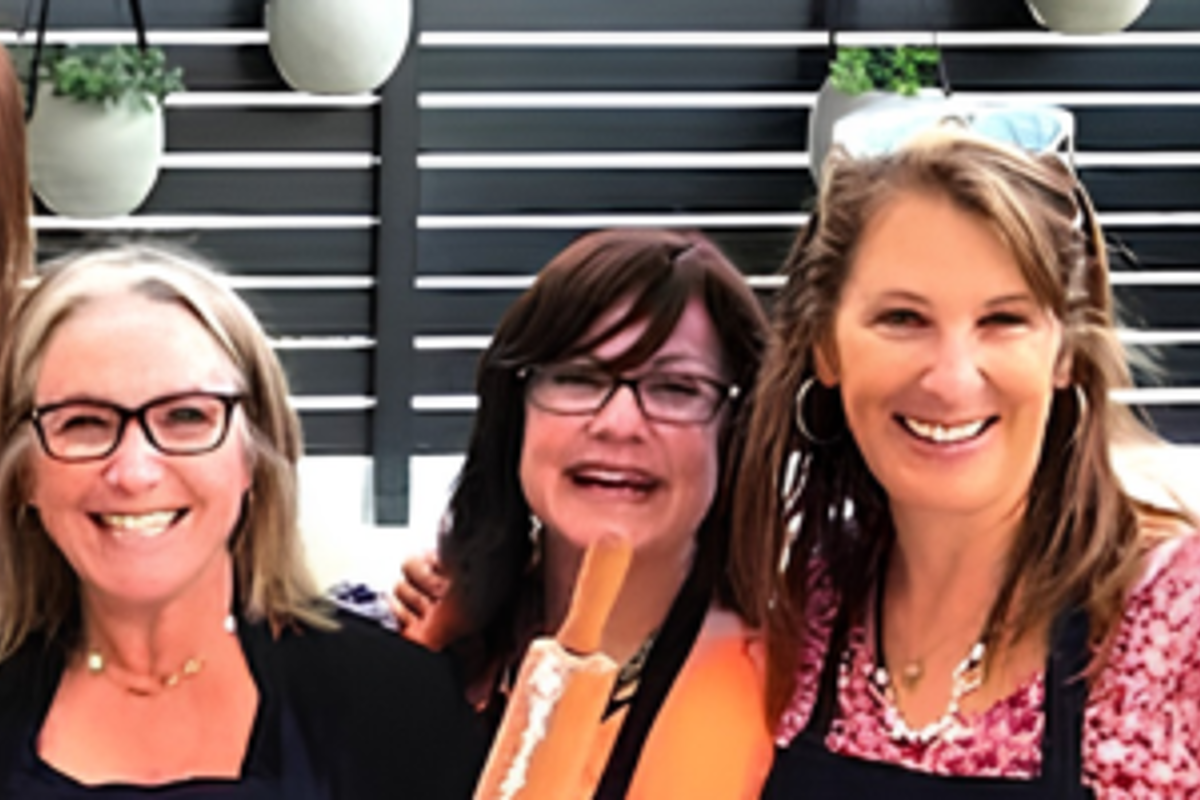
Laya Slavin was a hairdresser. She had been doing the work for years, and she was good at it, but she wanted to do something more directly impactful. She was considering a return to teaching, or nursing, and had decided to hang up her tools. Then a client came in who changed her mind, though not in the way she expected.
The client was not there for a regular appointment. She was going through chemotherapy and needed a wig. They say every hairdresser is also a therapist, and sitting in that chair, the woman began to talk. About her diagnosis. About the fear. About the particular weight of being unwell and still being expected to hold everything together. Laya listened, and by the end of the appointment she had made a decision. As her husband Rabbi Dovid Slavin puts it: “She realised, I can’t cure her. I’m not a doctor. I’m not a financial institution. But what I can and will do is give her a head of hair that’ll give her the courage to keep the fight going.”
Laya let go of all her other clients and devoted herself entirely to women in treatment. The appointments continued, and so did the conversations. One theme kept surfacing: dinner. Not in an abstract sense, but in the very specific sense of: I have to get in the car, find a park, walk the aisles, decide what to cook, and come home and make it. For a mother whose body is fighting for its life, that ordinary sequence of tasks can feel completely impossible. Some of these women were going home and pulling the blanket over their heads.
So Laya started sending meals home with them. “I have three dinners,” she would say. “I cooked, my husband ordered, we have leftovers.” Her one dinner would disappear and the Slavins would have sandwiches. Then friends started coming to help cook. Then the meals grew bigger than the wigs.
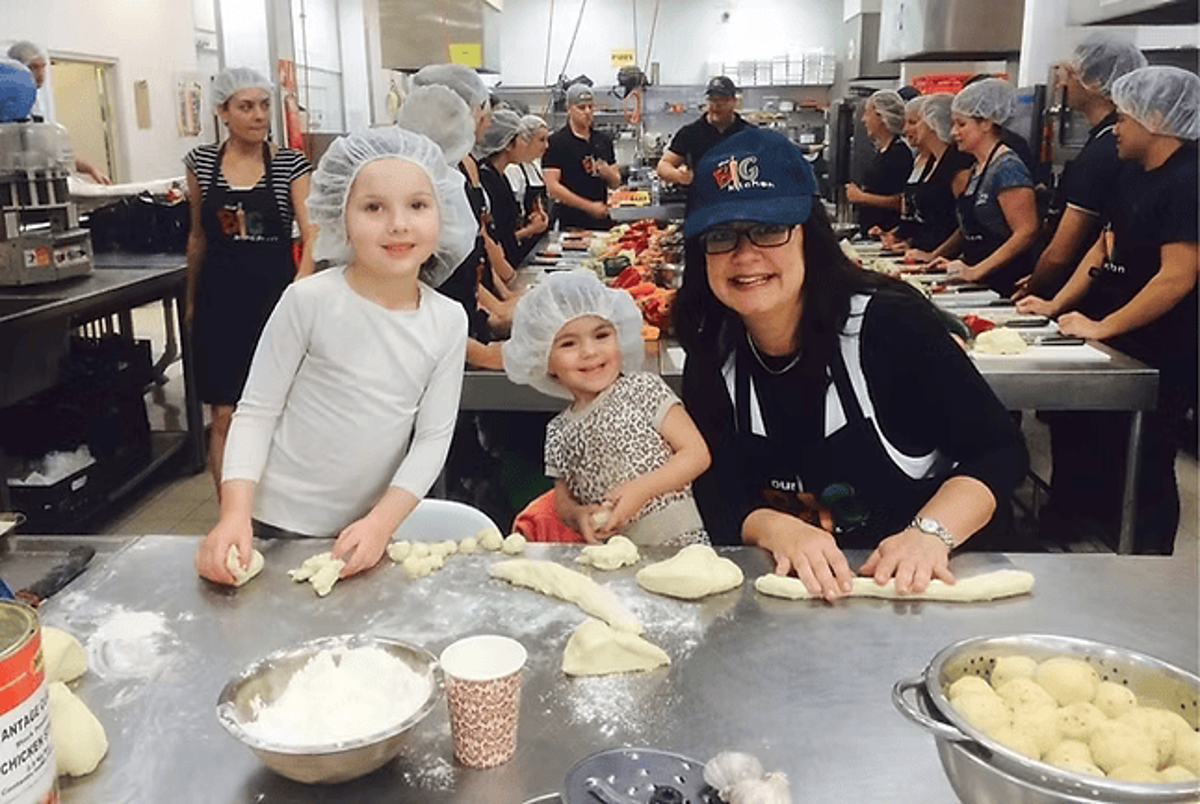
Dovid borrowed a commercial kitchen. He assembled eighteen volunteers, planned the recipes, the shopping list, the music. The day arrived and they cooked. Three things struck him: the sheer quantity of food that emerges when people cook together, the way the work becomes a celebration rather than a chore, and the look on his wife’s face. “I had never seen Laya happier,” he said.
He had spent the entire day preoccupied with one question: how do they do this properly, every day, in a place of their own? That evening, still cleaning up after everyone else had gone home, Laya appeared beside him. “Wow,” she said. “When are we doing this again?”
His immediate response -“If we do this again, we are going to build a kitchen that we and anybody else can use every single day.”
Around this time, Dovid had been reading about Shah Jahan, the Mughal emperor who built the Taj Mahal in memory of his wife Mumtaz Mahal after her death. The story stayed with him. “Take a look at what a dedicated and loyal husband does for his wife even after she is gone, and he is still trying to impress her,” he said. “If we have the privilege of sharing our life with somebody so special, we should do no less.” That, he says, is really how the kitchen came into being.
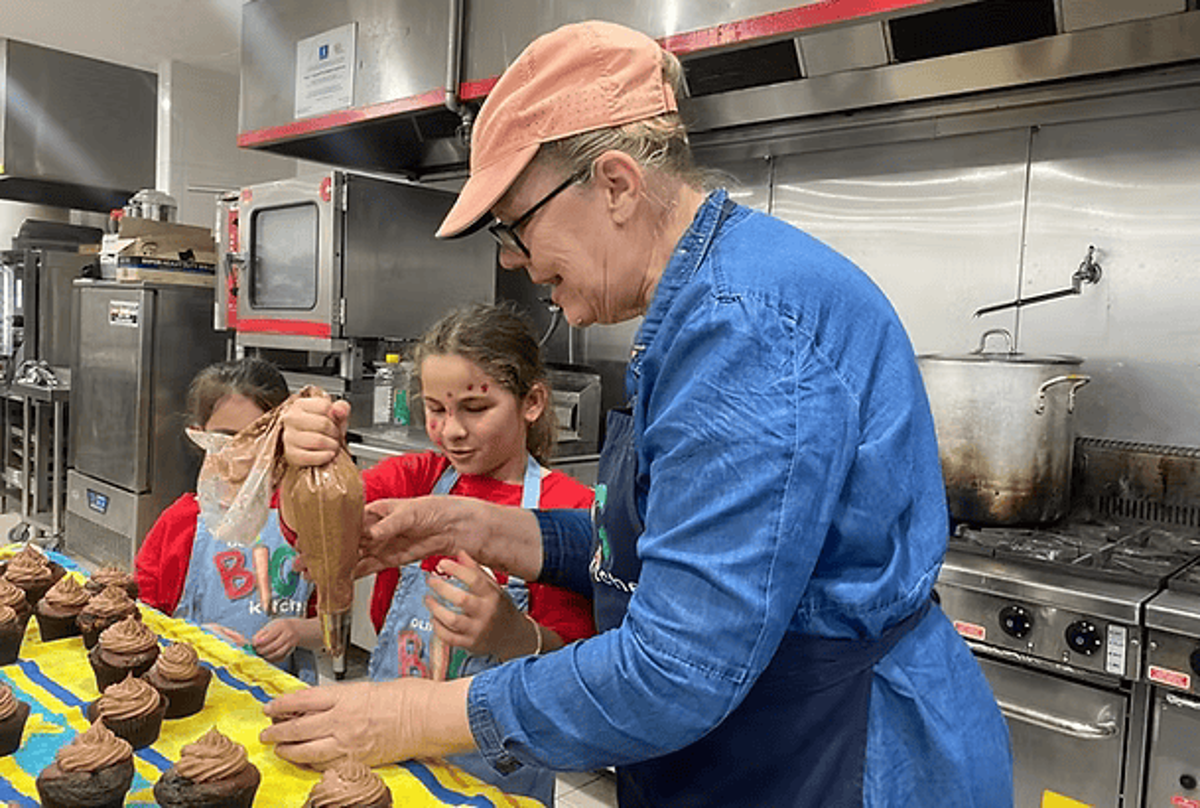
That borrowed kitchen had lit something neither of them could put back. The Slavins understood they needed something permanent, and that the need they were responding to was far larger than the circle of women Laya had been caring for. Rabbi Slavin had a vision: to transform the basement of the Yeshiva Centre in Bondi into a large-scale industrial kitchen open to anyone in the community. Others saw what he saw. A team of businesses, tradespeople and volunteers came together to make it happen. Our Big Kitchen opened in February 2005, and it has not closed since.
Twenty years on, Our Big Kitchen supports more than 35 charities across Sydney, distributing hundreds of thousands of meals each year. Among those relationships, one stands out for Rabbi Slavin with particular warmth: the partnership with the Bill Crews Foundation, and the Loaves and Fishes free restaurant in Ashfield.
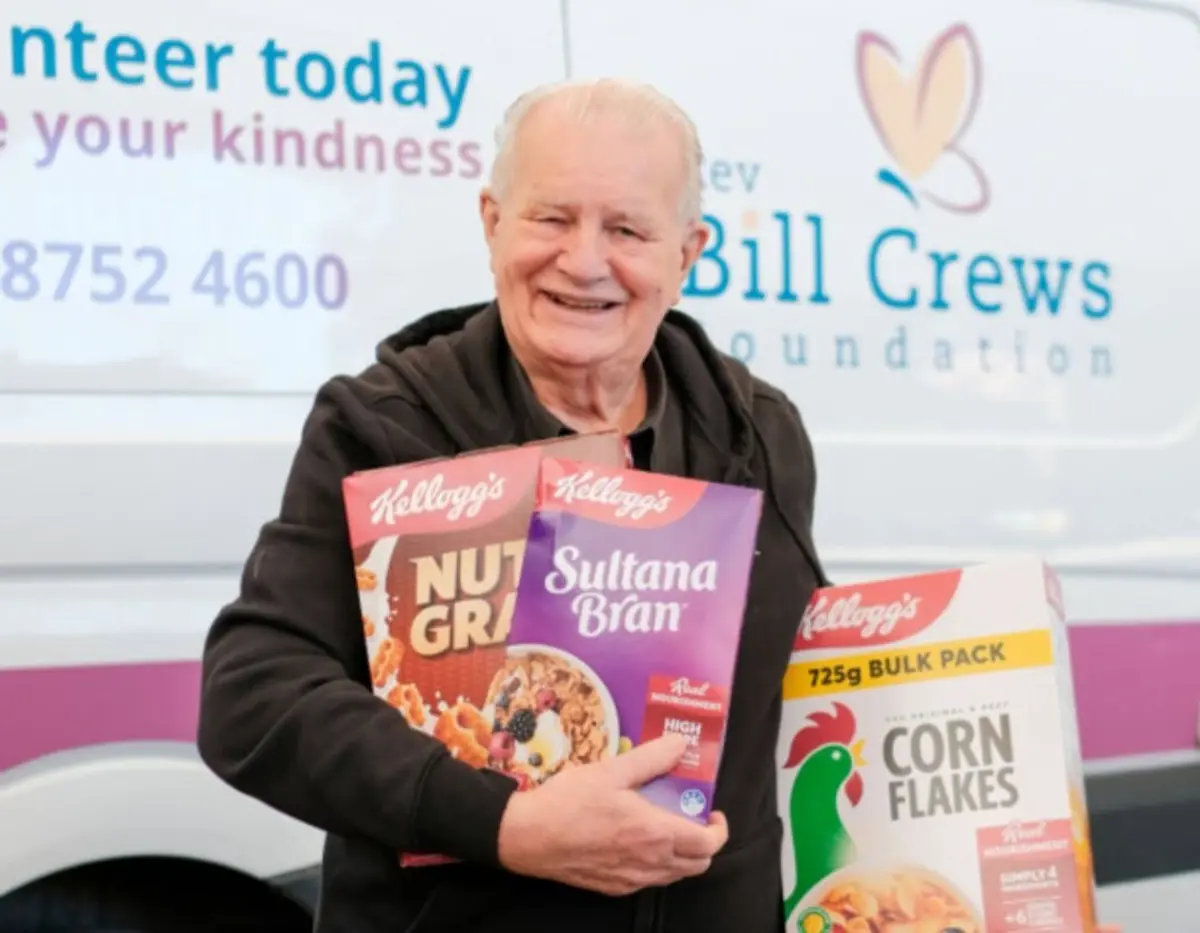
Rev. Bill Crews has spent decades showing up for the people Sydney would rather not see. The homeless. The addicted. The ones who have fallen through every available gap. When the Ashfield kitchen recently underwent renovations and temporarily closed, Our Big Kitchen stepped in without hesitation, sending 1,000 meals a day to keep Loaves and Fishes running. Not as a favour. As a matter of course.
“Bill Crews is an incredible Australian who has championed the needs of underprivileged people who the rest of society has little time for,” Rabbi Slavin said. “We and this country are better for it.” For him, the partnership is not complicated. A Jewish community kitchen and a Christian-founded organisation, both in the business of feeding people who need feeding. One table. Every tradition welcome.
It is exactly the kind of relationship the Uniting Church recognises and values: not an interfaith gesture, not a formal agreement, but two communities who share the same understanding of what it means to be responsible for one another. The call to feed the hungry, to show up for the vulnerable, to do so without fanfare, belongs to no single tradition. It never has.
On 14 December 2025, a terrorist attack on a Hanukkah celebration at Bondi Beach killed fifteen people and injured forty more. It was the first fatal antisemitic attack in Australian history. It happened at an event the Slavins had attended every year for thirty years without exception. This year, for the first time, they were overseas.
Their eldest son was there. Their daughter, her husband, and their two young grandchildren were there. From the other side of the world, Rabbi Slavin sat with his phone and tried to reach his children while hundreds of calls poured in simultaneously from people who knew him and feared the worst. He typed a single message and copy-pasted it over and over: “The Slavin family are accounted for. Please pray.” He sent it, he estimates, roughly a thousand times.
His family were physically unharmed. He counts himself and his family among the fortunate without any hesitation. But the pain of those who were not, the families who lost someone at that event, is something he carries permanently. “This was never my story growing up,” he said quietly. “It was always my parents’ story, my grandparents’ story. And now it is mine. And my children’s. And my grandchildren’s.”
If the attack was intended to cause the Jewish community to retreat, it produced exactly the opposite. Our Big Kitchen did not pause. It did not scale back. It multiplied, immediately and without deliberation, feeding overseas visitors who had flown in to lay wreaths, emergency workers stretched far beyond their limits, and a community held in shock. Volunteers arrived at the kitchen without being asked. People who had been at the periphery of Jewish community life for years suddenly showed up wanting to help, wanting connection, wanting to do something with their hands.
When I asked what kept him and his wife going through all of it, Rabbi Slavin thought for a moment before answering. There is a difference, he said, between paralyzing questions and empowering ones. After something like this, the mind reaches naturally for the paralyzing kind: Why did this happen? What is the world coming to? Who could do this to us? They are real questions, he said. Legitimate ones. But they lead nowhere. They immobilise.
The empowering questions are different. What is needed of me right now? What can I actually do? How do we support the families who have lost someone? How do we let our community know we are here and we are staying? Those were the questions the Slavins were asking from the very first day. “I thank heavens those are the questions we were asking,” he said.
His challenge to the wider Australian community is both honest and searching. Distancing yourself from violence is not enough, he said. That is only step one. The harder question is: who are we? Not who we are not. Who we are. What do we stand for? What does it actually mean to look after one another? “A society is judged not by how it treats those who are doing well, but by how it treats its most vulnerable. Children. The elderly. The poor. The disenfranchised.” That, he said, is the real message of religion. Any religion.
It is also, meal by meal, what Our Big Kitchen has been answering for twenty years. Laya, he says with unmistakable pride, is still not content to stop.
“You don’t fight darkness with a broom,” Rabbi Slavin said. “You don’t sweep it away. You light a candle. And when you light a candle, the darkness disappears.”
“Bill Crews is an incredible Australian who has championed the needs of underprivileged people who the rest of society has little time for,” Rabbi Slavin said. “We and this country are better for it.”
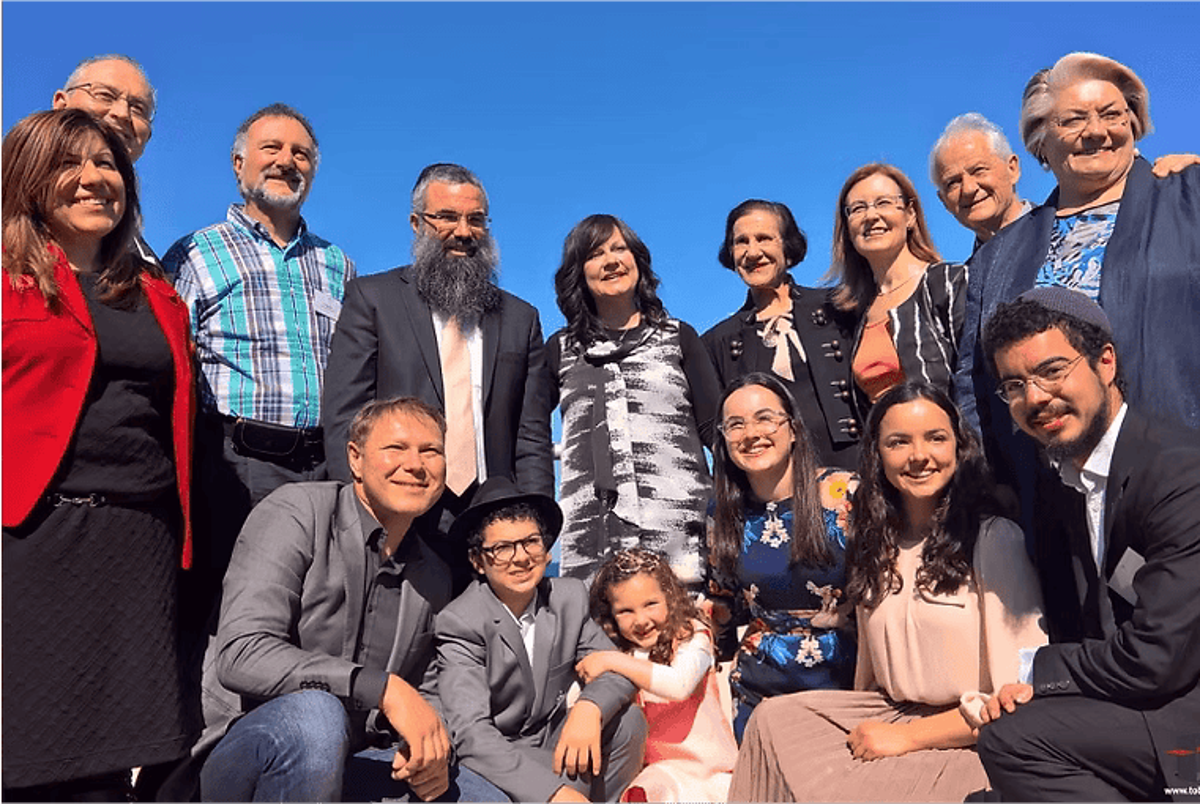
Our Big Kitchen welcomes everyone to volunteer, donate, or join them for a community meal. Shabbat Friday night dinners are open to all.